
A Founder's Guide to Twitter Followers Analysis for Leads
Turn your audience into customers. This founder's guide to Twitter followers analysis shows you how to find qualified leads and automate your outreach.
A smart Twitter followers analysis is your first step to turning passive followers into actual customers. It’s about shifting your focus from chasing big numbers to strategically finding high-value leads who already know and trust you.
Why Your Followers Are a Lead Generation Goldmine

Most founders glance at their follower count and see a number. But what if that list is really a pre-vetted database of your next best customers? That’s the whole game. You’ve already done the work to get their attention; now it’s time to figure out who they really are.
This isn’t about getting lost in spreadsheets. A good analysis is about spotting patterns. You're looking for the job titles, industry keywords, and common pain points hiding in plain sight within your audience’s bios and tweets.
From Vanity Metric to Dynamic CRM
Stop thinking of your follower list as a static audience. Start seeing it as a living, breathing CRM. Every person who hits "follow" has shown some interest in what you do. That simple action makes them way more valuable than a random name on a cold email list.
The goal is to stop chasing more followers and start attracting the right followers. Once you know who’s already listening, you can make smarter moves.
- Refine Your Ideal Customer Profile (ICP): An analysis will show you the actual job titles and industries of your most engaged followers, not just the ones you think you're targeting.
- Identify Warm Leads: You’d be surprised how many bios practically scream, "I am your perfect customer."
- Improve Your Content: When you know who you're talking to, you can create content that resonates, attracting more of the right people.
This analysis is your foundation for building targeted outreach campaigns. For example, if you find dozens of SaaS founders following you, you can craft DMs that speak directly to their challenges.
Key Takeaway: Stop looking at your follower count like a scoreboard. Start seeing it as a curated list of potential conversations. Every follow is an open invitation to connect.
The Competitor Cheat Sheet
One of the most overlooked hacks is analyzing your competitor's audience. Their follower list is a cheat sheet of people actively looking for solutions just like yours. They've already gathered your target market in one place.
By digging into their followers, you can uncover hundreds of qualified prospects who just might not know you exist yet. This is where social selling comes in, helping you turn those connections into real leads for your SaaS. And if you're looking to grow your own relevant audience first, check out our guide on how to increase followers on Twitter.
Whether you’re looking at your own followers or a competitor’s, this process turns raw data into intelligence you can act on, setting you up for personalized outreach that actually gets replies.
Setting Clear Goals for Your Analysis
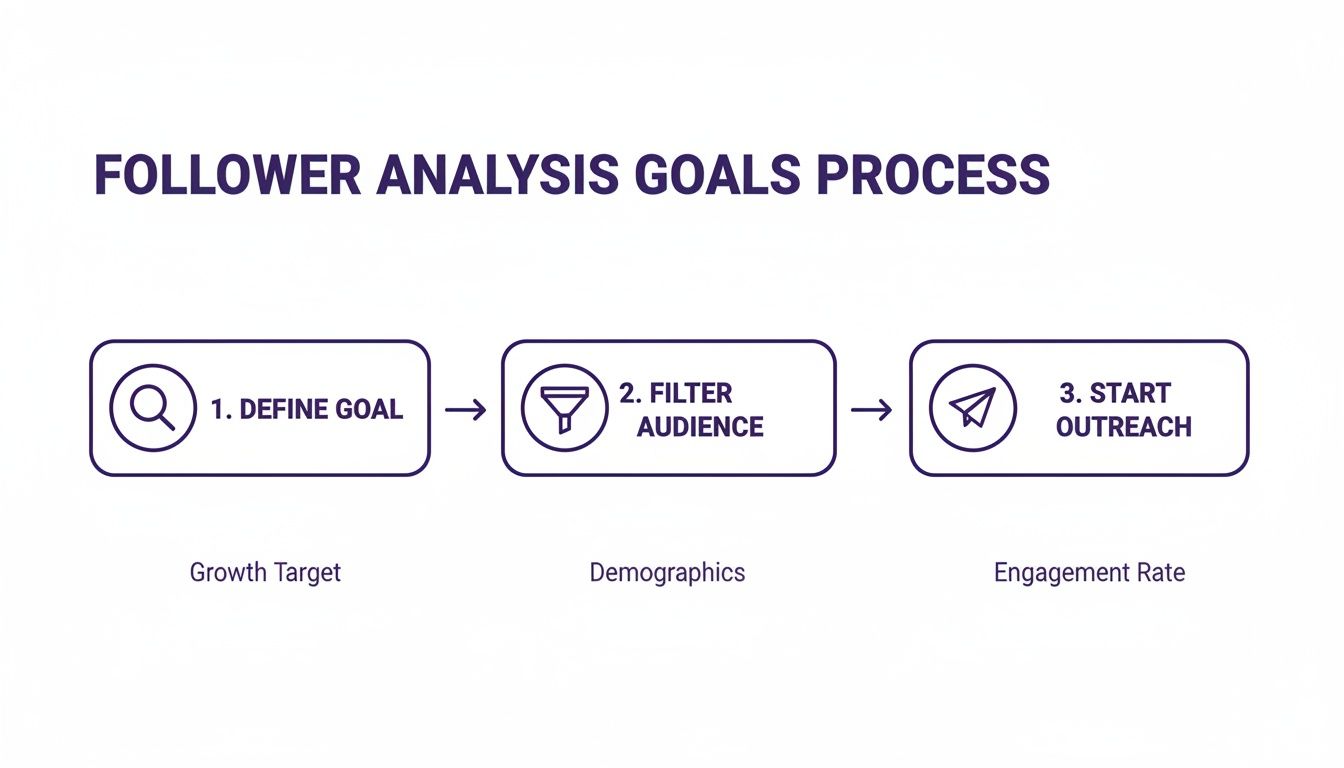
Jumping into data without a plan is a waste of time. Before you pull a single follower list, ask yourself one question: What does a "win" look like for my business right now?
This isn’t about vague goals like "get more leads." Get specific. Are you trying to find 50 SaaS founders in the Web3 space? Or maybe your target is 100 marketing managers at e-commerce brands.
A clear goal is your roadmap. It tells you exactly what to look for and what to do with the information you find.
From Vague Ideas to Actionable Targets
The first step is turning your business needs into measurable objectives. This decision shapes everything that follows, from how you gather data to the DMs you send.
Here are a few common goals for founders:
- Lead Generation: This is the big one. The goal is to identify a specific number of prospects who perfectly match your ICP. It’s the most direct path to growing revenue.
- Partnership Opportunities: You can also find influencers, potential affiliates, or other founders in your niche for collaborations.
- Fine-Tuning Your Content Strategy: Figure out the real job titles and interests of your audience so you can create content that pulls in more of the right people.
- Market Intelligence: Peek at a competitor’s followers to understand who they’re attracting. You’ll often find gaps in their strategy you can exploit.
Once you’ve locked in your objective, you can drill down. For lead generation, you don't just need to find people—you need an efficient way to start conversations. This is where a tool like DMpro.ai comes in handy, since it can find profiles that fit your criteria and handle the initial outreach.
Key Insight: Don’t just analyze data for the sake of it. Define a measurable outcome first. "Find 100 marketing VPs at US-based tech companies" is a real goal. "See who my followers are" is just a curiosity.
This table shows how to connect your goals directly to your analysis and outreach.
Matching Your Goals to Analysis and Action
| Your Goal | Analysis Focus | Actionable Next Step |
|---|---|---|
| Generate B2B Leads | Filter for job titles, keywords (e.g., "SaaS," "founder"), and company size. | Build a targeted list and start a personalized DM outreach campaign. |
| Find Co-Marketing Partners | Look for accounts with similar audience size, engagement, and niche. | Reach out with a specific collaboration idea (e.g., webinar, joint content). |
| Refine Content Strategy | Analyze the most common bio keywords, interests, and pain points mentioned by your followers. | Create a content calendar that addresses those specific topics and attracts more of your ICP. |
| Competitor Analysis | Identify the demographics and professional roles of a competitor's most engaged followers. | Pinpoint an underserved segment of their audience and target them with tailored messaging. |
Setting a clear goal is the most critical step to making sure your analysis actually leads to a valuable business outcome.
Finding Your Ideal Customer Profile on Twitter
Defining your goals forces you to get honest about your ICP. It’s one thing to have a profile written down, but it’s another to see if those people actually exist and engage on Twitter. Your analysis is the perfect way to validate your assumptions.
You might run the numbers and discover your content attracts product managers, not the CEOs you were targeting. That’s not a failure; it’s valuable intel. Now you can either tweak your content to attract CEOs or lean in and start marketing to PMs.
If you need a hand, our guide on how to identify your target audience offers a great framework for this.
This process is powerful when targeting specific regions. The United States, for instance, is the largest market on X with roughly 99.04 million active users. For SaaS founders, that's a massive pool of B2B prospects. You can dig into more global user statistics on Social Pilot to see just how big the opportunity is.
How to Gather and Segment Follower Data
Alright, you’ve got your goals. Now let’s get our hands dirty with the data. The objective is simple: pull the right information and sort it into groups that make sense for your outreach.
You don't need a data science degree; you just need to be smart about it.
Choosing Your Data Collection Method
Let's break down the three main paths you can take.
-
Manual Sampling: The quickest way to get a feel for an audience. Just scroll through a follower list (yours or a competitor's) and manually check out 50-100 profiles. It's low-tech, but you'll spot patterns in job titles and bios almost immediately. Perfect for validating an idea.
-
Third-Party Export Tools: When you need to scale, tools can export follower lists into a CSV file. This gives you a spreadsheet full of raw data—usernames, bios, locations, etc. It's powerful, but you'll need to be comfortable with Excel or Google Sheets.
-
Automated Platforms: For serious lead generation, this is the way to go. Platforms like DMpro can handle the whole process. They’ll scrape follower lists, filter them based on your rules (like keywords and follower count), and feed them right into an outreach campaign, bypassing the manual spreadsheet work.
For most founders trying to scale distribution, the manual approach is a good start, but automation is where you build a repeatable pipeline.
The Data Points That Actually Matter
Once you have a spreadsheet, ignore most of it. For lead gen, you only need to focus on a few key things that signal someone is a good fit.
Here’s what to zero in on:
- Bio Keywords: This is your goldmine. Hunt for terms like "founder," "CEO," "marketing," "SaaS," or any industry-specific language that matches your ICP.
- Location: If you're targeting a specific region, this is a non-negotiable filter.
- Follower/Following Count: A huge follower count might mean they're an influencer, while a more balanced ratio often signals a real person.
- Recent Activity: Check their last tweet. If someone hasn't been active in months, they're not a quality lead.
These data points are the building blocks for creating useful segments.
Founder-to-Founder Tip: Don't just look for job titles. Look for pain points. Bios that say things like "building in public" or "struggling with churn" are massive buying signals. That's your cue to start a conversation.
From Raw Data to Actionable Segments
Segmentation is where the magic happens. A raw list is noise; a segmented list is a targeted outreach plan. The goal is to create a few distinct "buckets" so you can tailor your message.
Here are a few segments to start with:
- Ideal Customers: Profiles that tick every box—the right job title, industry, and keywords.
- Industry Influencers: People with a large, engaged following in your niche. Approach them as potential partners.
- Potential Partners: Other founders or businesses in adjacent spaces. Outreach should be about collaboration, not sales.
- Engaged Fans: Followers who consistently interact with your content. Nurture these relationships—they are your brand advocates.
By segmenting your list, you send the right message to the right person. This level of detail is why digging into your X (Twitter) account analytics is so crucial for growth.
Tapping into Your Competitor's Audience to Find Hidden Leads
Why spend months building an audience from scratch when your competitors have already done it for you? Analyzing the follower lists of top accounts in your niche is the fastest way to find warm, qualified leads.
These people have already shown interest in the exact solutions you offer. By digging into the followers of your direct competitors or major influencers, you get a pre-vetted list of prospects. It’s a massive shortcut.
A Founder's Guide to Competitor Analysis
This doesn't have to be complicated. Just pick three to five key accounts to analyze—direct competitors or influencers with an audience that matches your ICP.
The goal isn't just to scrape usernames. You're hunting for intelligence to give you an edge in the DMs.
- Job Titles & Bio Keywords: What roles and industries keep popping up? Look for keywords like "Founder," "Growth," "SaaS," or whatever is relevant to your product.
- Language & Pain Points: Pay attention to the words in their bios and tweets. Are they talking about "scaling," "MRR," or "reducing churn"? These are the problems you solve.
- Content Engagement: Zero in on people actively liking and replying to your competitor's posts. These are their most engaged followers and your warmest leads.
This intel turns a spammy DM into a personalized message that gets a reply.
The Big Idea: This isn't about "stealing" followers. It's about understanding the market conversation and finding prospects who are already looking for what you offer.
How to Spot High-Value Segments
Not all followers are created equal. As you scan a competitor's list, you'll start to see patterns. This is where you segment them into actionable groups for tailored outreach.
Bucket them into groups like:
- Ready-to-Buy Prospects: Profiles that scream "perfect customer." Their bio, recent tweets, and engagement all line up.
- Unhappy Campers: Keep an eye out for anyone complaining about your competitor. A tweet about a missing feature is a golden opportunity to jump in.
- Audience Overlap: It's valuable to see who follows multiple key players in your space. This signals high interest. You can explore follower overlap on our tools page to see how interconnected these audiences are.
This is where automation becomes your best friend. Instead of manually sifting through thousands of profiles, a tool like DMpro can scrape these follower lists for you. You can set up filters based on keywords, location, or follower count and get a clean list of leads ready for outreach.
This approach works because you're plugging into the network effect influential accounts have already built. Take Elon Musk, with over 229 million followers. You're not targeting all of them. But within that massive audience are pockets of decision-makers. Imagine using a tool to scan his followers and pull out every tech founder and VP—that's the power of targeted analysis. The sheer scale, which you can see on lists like the most followed accounts on Wikipedia, shows how much opportunity is out there.
Turning Your Analysis Into Automated Outreach

Analysis is useless if you don't act on it. You’ve identified your ideal customers and segmented them. Now, it’s time to connect.
But let’s be real, no founder can manually send hundreds of personalized DMs every day. That’s a path to burnout. This is where you scale your outreach without losing the human touch.
Crafting DMs That Don't Get Ignored
The insights from your analysis are the ingredients for messages that get replies. Generic templates are dead. Your goal is to prove you've done your homework.
Your analysis gives you the perfect conversation starters.
- Reference a recent tweet: "Saw your post on MRR benchmarks—we've been thinking about that a lot too."
- Mention a shared interest: "Noticed from your bio you're into 'building in public.' Big fan of that approach."
- Point out a common connection: "Looks like we both follow [Influencer Name]. Their content on scaling SaaS is great."
These are just human conversation starters. They show you see the person, not just a profile, which separates you from 99% of spammy DMs.
Founder-to-Founder Tip: Your first message should not be a sales pitch. It should be a conversation starter. Ask a question, offer a compliment, or share a thought. The goal is to get a reply.
Automation Is Your Unfair Advantage
This is where it all comes together. Personalized outreach is effective, but it’s impossible to scale manually. Automation is your secret weapon for building a predictable sales pipeline.
You can take the criteria you identified during your analysis and plug it directly into an automation platform. This turns your research into a 24/7 lead generation engine.
Building Your Automated Outreach Machine
Imagine a campaign that runs on autopilot while you build your product. This is possible with the right setup.
Here’s how it works. You define your ideal lead with precision.
For example, you could target:
- Audience: Followers of a specific competitor.
- Bio Keywords: Must contain "SaaS founder" or "B2B growth."
- Follower Count: Between 1,000 and 10,000 followers.
- Recent Activity: Tweeted about "MRR" or "churn" in the last week.
Once you set these rules, the system gets to work. This is exactly what a platform like DMpro.ai is built for. It scans Twitter for profiles matching your criteria and sends out your personalized, non-spammy DMs.
The AI can even handle initial replies to qualify leads before handing the conversation to you. It's like having a sales rep who never sleeps.
From Manual Grind to Predictable Pipeline
The end game is to stop chasing leads and build a system that delivers them consistently. By combining a smart Twitter followers analysis with intelligent automation, you create a powerful and scalable distribution channel for your SaaS.
This is about sending the right message to the right person at the right time—at a scale that would be impossible for a human. This is how you build a real sales pipeline on Twitter that brings in new conversations every single day.
If you’re tired of manually sending DMs every day, check out how DMpro.ai automates outreach and replies while you sleep.
Your Blueprint for Twitter Lead Generation
<iframe width="100%" style="aspect-ratio: 16 / 9;" src="https://www.youtube.com/embed/QWeQzPCF2iQ" frameborder="0" allow="autoplay; encrypted-media" allowfullscreen></iframe>We've covered the entire playbook, from setting goals to automating outreach. The key takeaway is that Twitter followers analysis isn't a one-time task. It’s a repeatable system for creating a consistent flow of high-quality leads.
When you analyze your audience and competitors' followers regularly, you’re building a powerful, predictable distribution channel for your business. It’s about working smarter, not harder.
Final Thought: With the right game plan and tools, you can build a lead generation engine that runs itself. Start small, see what messaging works, and then scale what’s effective.
This approach shifts your mindset from manual prospecting to building a system. It frees you from the grind and lets you focus on the conversations that close deals and grow your company.
If you’re ready to stop sending DMs by hand, give DMpro.ai a look. It can handle outreach and initial replies while you focus on your product.
Common Questions Answered
When you start digging into Twitter follower analysis for leads, a few questions always pop up. Let's clear up the common sticking points.
How Often Should I Be Analyzing Followers?
It depends on your goal.
For active lead generation, a quick review of new followers (yours and your competitors') on a weekly basis is perfect. This keeps your pipeline fresh.
For the bigger picture, a deep dive into your entire audience every quarter is a game-changer. This is where you spot major trends and refine your customer profile.
Of course, with an automated tool, the analysis becomes a constant process. A platform like DMpro is always scanning for new profiles that match your criteria, so you’re effectively running an analysis 24/7 without any manual effort.
What Profile Metrics Actually Matter?
It's easy to get lost in data. For finding quality leads, only a few signals matter.
Focus on what tells you someone is a good fit:
- Bio Keywords: This is everything. Look for job titles, industries, or interests that scream "ideal customer." Think "SaaS Founder," "ecom," or "investor."
- Recent Activity: A recent tweet shows they are actually on the platform. An inactive account is a waste of time.
- Follower-to-Following Ratio: A balanced ratio often indicates a real, engaged person, not a bot.
These three things give you 90% of what you need to know.
Should I Analyze My Followers or a Competitor's?
Both. They serve two different, but equally critical, purposes.
Analyzing your own followers is about finding low-hanging fruit. These are warm leads who already know and trust you.
Analyzing a competitor's followers is a powerful engine for fresh lead generation. You're tapping into a pre-qualified pool of people interested in solutions like yours.
Pro Tip: A good rule of thumb is to start with competitors for cold outreach and nurture your own followers to build a stronger community and distribution.
How Do I Avoid Getting My Twitter Account Suspended?
This is a valid fear with automation. The secret is to make your automation act like a human, not a spam-bot. Blasting hundreds of identical DMs is a surefire way to get flagged.
Personalization is your best friend. Use different message templates, reference something from their profile, and always respect Twitter's rate limits.
A smart platform like DMpro is built for safety. It uses human-like sending delays and monitors your account's health, letting you scale your outreach without putting your account at risk.
If you’re tired of manually sending DMs every day, try DMpro — it automates outreach and replies while you sleep. Find out more at https://dmpro.ai.
Ready to Automate Your Twitter Outreach?
Start sending personalized DMs at scale and grow your business on autopilot.
Get Started Free