
A Founder's Guide To The Twitter Suspension Appeal Process
Account suspended on X? This guide covers the entire Twitter suspension appeal process with actionable tips and templates to get your account back online.
When you get that dreaded notification, a Twitter suspension appeal is your channel to ask X (the platform we all still call Twitter) to take a second look and get you back online. A good appeal hinges on one thing: clearly understanding why you were suspended and then explaining your side of the story calmly and concisely.
The key is not to panic. What you do in that first hour is critical for building a strong case.
Your X Account Is Suspended What To Do First

It’s a gut-punch, isn't it? One minute you’re deep in your outreach, managing a solid pipeline of leads on X. The next, that suspension notice pops up, and your whole distribution channel grinds to a halt. For founders, X is a vital channel for lead gen, so a suspension can feel like someone just boarded up your shop window.
The first impulse is usually to fire off a frantic, maybe even angry, appeal.
Stop. Don't do it. The steps you take in this first hour can genuinely make or break your chances of getting the account back. Rushing the process is the single biggest mistake people make. Just take a deep breath and switch from panic mode to strategy mode. The goal here isn't just to reclaim your account; it's to figure out what happened so you can prevent it from happening again.
Figure Out if It Is a Lock or Suspension
First things first, you need to confirm exactly what you're dealing with. X has a couple of different ways it can restrict your account, and the label matters. Are you looking at a temporary lock or a full-blown suspension?
- Temporary Lock: This is more of a security check. X might think your account was hacked or that you're a bot. You can usually clear this up in minutes by verifying your phone number or email. Think of it as a warning shot.
- Suspension: This one is serious. It means X has decided your account broke the rules. Suspensions range from temporary to permanent and almost always require a formal appeal. The notice will usually point to a broad policy, like "Platform Manipulation and Spam."
Knowing the difference is vital. A lock is a simple fix, but a suspension demands a careful and well-written twitter suspension appeal.
Avoid These Common Knee-Jerk Reactions
In that initial hour, what you don't do is just as important as what you do. Fight the urge to make these common mistakes that can sink your appeal before it even starts.
Take a step back. A rushed, emotional appeal filled with frustration will almost certainly be ignored by the review team. Professionalism and clarity are your best assets.
The biggest no-no is immediately creating a new account to get around the suspension. This is a huge violation of X's rules and will likely get the new account banned, too. It tells X that you’re trying to evade the problem instead of solving it.
Another thing to avoid is spamming the appeals form. Sending appeal after appeal won't get you a faster response. In fact, it just clogs their system and might flag you as a nuisance, making it less likely that a real person will give your case the time it deserves. Your first appeal needs to be your best one, and that means preparing it properly.
Getting To The Bottom Of Why You Were Suspended
Before you even think about writing an appeal, you need to play detective. Just firing off a generic "I didn't do anything wrong" message is the fastest way to get your appeal ignored. You have to figure out the specific rule X's system flagged you for, and that means taking an honest look at your recent activity.
For those of us using X for outreach and scaling our SaaS distribution, the most common trap is the big, vague category of "Platform Manipulation and Spam." It’s a huge umbrella that covers everything from following too many accounts to sending a blast of similar DMs. Even a perfectly legitimate, high-volume campaign can look like spam to an algorithm that doesn't understand your business goals.
The system doesn’t know you're a founder trying to connect with potential customers; it just sees patterns. A sudden jump in activity, sending the same message repeatedly, or following hundreds of accounts in a day can all set off alarm bells. Your appeal needs to directly address the specific pattern that likely got you into trouble.
Common Suspension Triggers
Let's break down what usually goes wrong. Most suspensions for founders aren't about being malicious. They're about pushing the platform's limits, often without realizing it. The system is built to catch bots, and sometimes, our outreach can look a lot like a bot.
To help you pinpoint the issue, here's a breakdown of the most frequent suspension reasons and what they usually mean for founders like us.
Common Suspension Reasons And What They Mean For You
| Suspension Reason | Common Triggers for Marketers | Key Appeal Focus |
|---|---|---|
| Spam/Platform Manipulation | - Aggressive follow/unfollow tactics<br>- Sending high-volume, repetitive DMs<br>- Posting the same link repeatedly | Acknowledge the high activity, explain the business context (e.g., product launch), and promise to adjust your strategy. |
| Abusive Behavior | - Sending unsolicited, aggressive sales pitches<br>- Mentioning users repeatedly without context<br>- Using overly assertive or demanding language | Apologize for any messages that came across poorly, clarify your intent was professional, and commit to a more respectful tone. |
| Compromised Account | - Sudden, unusual activity from your account<br>- Logging in from multiple strange locations<br>- Using automation tools that aren't secure | Focus on securing your account (mentioning you've changed your password and enabled 2FA) and state you were not in control. |
Understanding these categories is your first step. It's all part of the complex world of social media content moderation, which relies heavily on algorithms that can't always tell the difference between a bot and a determined founder.
If your account just feels restricted but isn't fully suspended, it might be something else entirely. We've got a guide for that, too: Learn more about how to check if you are shadowbanned on X in our article.
Match Your Actions to the Suspension Notice
Okay, now pull up that suspension email or notification from X. It probably gives you a broad reason. Your goal is to connect that vague category to your specific actions on the platform.
Think about what you were doing in the 48 hours before the suspension hit.
- Were you running a new DM campaign?
- Did you just upload a big list of leads to follow?
- Did you switch up the copy in your automated messages?
Your most recent, high-volume activity is almost always the culprit. Be brutally honest with yourself about what might have crossed a line, even accidentally. This self-diagnosis is the single most important part of the process.
It helps to understand the sheer scale of X's moderation efforts. One recent transparency report showed 5.2 million account suspensions for rule violations—a massive increase from previous years. This points to a much more aggressive, algorithm-first enforcement policy, and you have to play by these new rules.
If you guess the wrong reason, you'll write a weak, irrelevant appeal that will get rejected instantly. Get this diagnosis right, and you've already won half the battle.
How To Write A Twitter Suspension Appeal That Works
Alright, you've figured out what went wrong. Now for the most important part: writing the actual appeal. This isn't the time for a novel or an emotional rant. Your goal is to be professional, concise, and, most importantly, human.
The person on the other end is likely sifting through hundreds of these cases. Clarity and respect will get you much further than anger. Think of it as a simple business email—you're explaining a situation, showing you understand the rules, and promising to be a good citizen on their platform moving forward. A clear, logical argument is your best shot.
The whole process really boils down to three key stages: analyze, diagnose, and prepare.
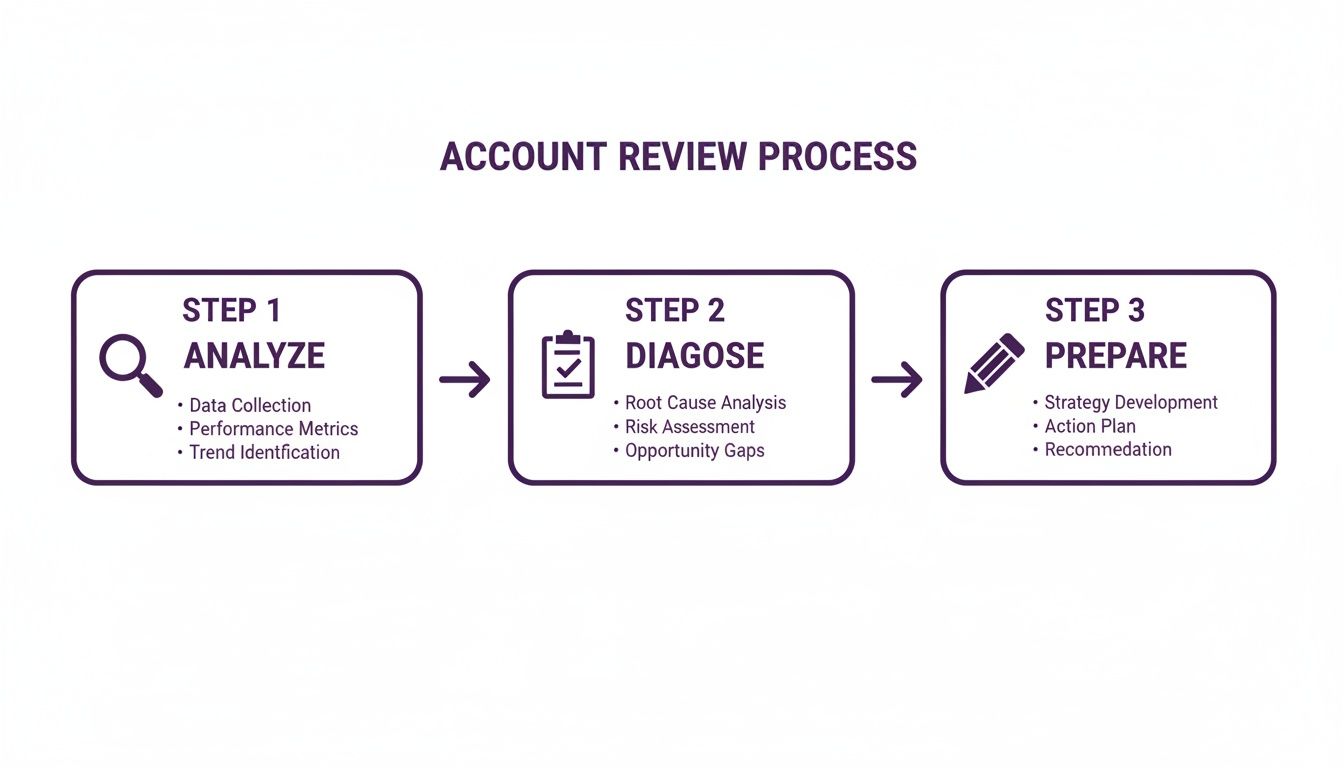
As you can see, a successful appeal doesn't just happen when you start typing. It’s built on a foundation of careful analysis and a solid understanding of the problem.
The Anatomy Of A Winning Appeal
Every effective appeal, whether it's a few sentences or a few paragraphs, has three core components. You absolutely need to hit each of these points to show you’re taking this seriously.
-
Acknowledge the Violation (Carefully): Start by showing you understand why you might have been flagged. You don't have to fall on your sword and admit to being a spammer, but you should demonstrate that you've actually read the rules.
-
Explain Your Business Context: This is your chance to be human. Briefly explain that you’re a founder using X for legitimate business outreach. Context really matters here—it’s what separates you from the actual bad actors.
-
Commit to Compliance: Wrap it up by stating clearly that you’ve reviewed the rules and will make sure your future activity is in line with them. This shows respect for the platform and its policies.
The tone is everything. Avoid blaming the algorithm or making excuses. Just state the facts from your perspective and show you're willing to cooperate.
Here's a key thing to remember: the person reading your appeal isn't the one who suspended you. Their job is to review the case. Make it easy for them to say "yes" by giving them a clear, professional reason to do so.
Battle-Tested Appeal Templates
We've seen a lot of these. Here are a few templates tailored to common situations we see with founders. Don't just copy-paste them. Use them as a starting point and customize the details to fit your exact situation.
Template 1: The Honest Mistake
This one's for when you genuinely think you crossed a line, maybe with an overly aggressive follow campaign or a new DM sequence that was a bit too repetitive.
- "Hello, my account [@YourHandle] was recently suspended, and I believe it may have been due to a high volume of activity from a new marketing campaign. I understand now that this level of outreach may have been flagged as spam. This was an honest mistake; our goal is to connect with relevant professionals in our industry. I have reviewed X’s rules on platform manipulation and will adjust my strategy to ensure full compliance moving forward. Thank you for reconsidering my case."
Template 2: I Believe This Is An Error
Use this if you’ve gone through your activity with a fine-tooth comb and genuinely can't find a clear violation. It’s polite but firm, suggesting the suspension might have been an algorithmic hiccup.
- "Hello, I am writing to appeal the suspension of my account [@YourHandle]. I have carefully reviewed X’s rules and my recent account activity, and I honestly believe this suspension was made in error. My account is used for professional networking and sharing industry news. I am committed to following all platform rules and would appreciate a second review of my account. Thank you for your time and consideration."
Template 3: The Automation Tool Defense
This is the one to use when your outreach automation tool might be the culprit. It takes responsibility while explaining the technical context. This is especially relevant if you're using a tool like DMpro, which is built for safety but can still be configured too aggressively if you’re not careful.
It's also a good idea to make sure your past activity is clean. If you need to do a bulk cleanup, for example, it’s worth learning how to delete tweets from your archive before you send the appeal.
- "To the X Support Team, my account [@YourHandle] was suspended, and I suspect it may be related to the settings on a third-party automation tool I use for lead generation. It appears my recent configuration may have unintentionally violated the rules regarding aggressive following or messaging. I have since paused all automation and am reviewing my settings to ensure they are well within X’s guidelines. My intent is purely for business development, not spam. I am committed to using your platform responsibly. Thank you for your review."
When crafting your appeal, clarity and precision are your best friends. Getting good at legal writing in plain English can make a real difference, helping you present your case in a way that’s easy for the review team to understand and approve.
The Waiting Game: How Long Until You Hear Back?
<iframe width="100%" style="aspect-ratio: 16 / 9;" src="https://www.youtube.com/embed/auOYXJl4P6E" frameborder="0" allow="autoplay; encrypted-media" allowfullscreen></iframe>Alright, you’ve done everything right. You figured out what went wrong, wrote a solid appeal, and sent it off. Now for the really tough part: waiting. The silence can be deafening, especially when your business relies on X for leads.
Let's get one thing straight—there's no official timeline from X. You might get a reply in 24 hours, or you could be waiting for weeks. The unfortunate reality is that many appeals feel like they've been sent into a black hole. You often don't even get a confirmation email, leaving you completely in the dark.
This isn't just a hunch; it's a known issue. Since the big platform shake-up, the moderation and appeals process has been, to put it mildly, chaotic. In just one week, X suspended nearly 500,000 accounts, and the system has been overwhelmed ever since. I’ve heard from countless founders, even those with Premium subscriptions, whose appeals seem to vanish without a trace. If you want to go down the rabbit hole, you can read more about the sheer scale of Twitter suspensions and the broken appeals process to see just how big the problem is.
How to Follow Up Without Annoying Them
With all this uncertainty, "wait and hope" isn't a viable strategy. You need a plan for following up that's persistent but still professional. The last thing you want to do is spam the support team and get your appeal flagged as a nuisance.
Here’s a simple, respectful schedule I've seen get results:
- Your First Check-In: Give it 7 days after submitting your appeal. If you’ve heard absolutely nothing—not even an automated response—it’s reasonable to send a polite follow-up.
- Ongoing Follow-Ups: From then on, ping them once a week. Any more than that, and you risk hurting your case.
Keep your follow-up message short and sweet. The best way is to simply reply to your original appeal email (if you got a case number) to keep everything in one thread.
"Hello, I'm following up on the appeal for my account, [@YourHandle], which I submitted on [Date]. I know your team is incredibly busy, but I would be grateful for any update on my case. Thank you for your time and consideration."
This shows you're organized and serious, not just another angry user firing off emails. It’s about being patiently persistent.
Reading the Tea Leaves and Knowing When to Pivot
While you’re in this holding pattern, pay attention to any subtle changes. Sometimes you'll see a sign before you get an official email.
Try logging into your suspended account every few days. Can you suddenly view your profile, even if you can't tweet? Has the specific suspension notice changed? These can be little clues that a real person is finally looking at your case.
There also comes a time when you need to be realistic. If a month has passed and all you've heard is crickets despite your weekly check-ins, the chances of getting that account back start to look pretty slim.
This is exactly why a backup plan is non-negotiable for anyone serious about using X for outreach. It’s the reason smart founders use a multi-account strategy from day one. A tool like DMpro lets you manage multiple accounts from a single dashboard, spreading your outreach activity across them. That way, if one account gets suspended, your entire lead generation machine doesn't come to a screeching halt. This isn't about breaking the rules—it's about building resilience.
How To Prevent Future Account Suspensions

Getting your account back is a huge relief. But the real win isn't just getting it reinstated—it's keeping it safe for good. This is where you need to switch from damage control to a proactive strategy, building a system that keeps your lead pipeline flowing without constantly looking over your shoulder.
For anyone using automation to scale outreach on X, this isn't optional; it's a core business practice. You can't build a predictable revenue stream on an account that could vanish overnight. The secret is to automate smartly, not just aggressively. It's all about knowing the rules of the road and building your strategy around them from day one.
Play By The Platform's Rules
This sounds obvious, but it's the foundation of everything. You have to respect the platform's limits. X is intentionally vague about the exact number of DMs or follows you can send per day because it’s not just about raw numbers. It's about the pattern of your activity.
Think of it this way: blasting 50 identical DMs in five minutes screams "bot." Sending 100 slightly different messages spread out over a few hours, on the other hand, looks far more human. The algorithm is designed to spot robotic behavior, not just high volume.
The goal isn't to redline the limits. It's to operate so comfortably within them that you never even get close to the edge. Sustainability beats short-term volume every single time.
This goes for your message content, too. The platform's policies are getting tighter. In just the second half of 2020, Twitter took action against a staggering 1,126,990 accounts for hateful conduct, a 77% jump. This shows just how seriously they're cracking down on content, a clear warning for anyone doing cold outreach. You can see what Twitter's enforcement actions look like on TIME to get a better sense of the landscape.
Mix Up Your Messaging And Your Accounts
Sending the same canned message to hundreds of people is one of the fastest ways to get your account flagged. It's the digital version of a robocall, and X’s spam filters are built to shut it down.
Your message templates need variety. Use spintax or dynamic fields to pull in a prospect's name, their company, or something from a recent tweet. Even tiny tweaks can make each message unique enough to fly under the radar. The more personalized your outreach feels, the safer—and more effective—it will be.
Diversifying your accounts is another game-changer. Relying on a single account for all your outreach is like building your business on rented land with a moody landlord. If that one account gets suspended, your entire lead flow dries up instantly.
That's why multi-account management is your best insurance policy. By spreading outreach across several accounts, you lower the activity on any single profile, making your entire operation look more natural. Tools like DMpro are designed for exactly this, letting you run campaigns from multiple profiles with smart inbox rotation. If one account gets a temporary slap on the wrist, the others keep the engine running. No lost momentum.
Use The Right Tools For The Job
Not all automation tools are created equal. Some are just blunt instruments built to blast out as many messages as possible, with zero regard for your account's safety. Those are the tools that give automation a bad name and put you on the fast track to a permanent ban.
You need a tool that was built with compliance and safety as its main features. Look for specific functions that actively protect your accounts:
- Human-like Delays: The software should automatically add random delays between actions (like follows and DMs) to mimic how a real person would behave.
- Real-time Health Monitoring: A good platform will keep an eye on your accounts for warning signs—like a sudden drop in engagement—and alert you before a suspension hits.
- Smart Rotation: As mentioned, the ability to automatically switch between different sender accounts is non-negotiable for managing volume safely.
- Proxy Support: Using high-quality residential proxies makes it look like each of your accounts is operating from a different, legitimate location, adding a powerful layer of security.
For a deeper dive into the nitty-gritty, check out our guide on understanding the Twitter DM limit and how to work around it safely. It really breaks down how to find that sweet spot between volume and safety.
Ultimately, preventing another twitter suspension appeal boils down to one thing: treat X like a long-term strategic asset, not a channel to be squeezed dry. Build a sustainable system, use smart tools, and you’ll create a lead generation machine that runs safely for years.
Common Questions About The Appeal Process
We get it. The whole Twitter suspension appeal process can feel like a black box. You’ve shot your appeal out into the void, and now you’re just waiting, wondering what’s happening on the other side. Let's tackle some of the most common questions we hear from founders who've been in your exact spot.
How Long Does A Twitter Suspension Appeal Take
Honestly, there’s no magic number here. Anyone who gives you a firm timeline is just guessing.
We’ve seen responses pop up in as little as 24 to 72 hours, but it's far more common to be left waiting for several weeks. Sometimes, you never hear back at all, which is the most frustrating outcome.
The best plan of attack is to submit one clear, well-written appeal and then settle in. If you don't even get an automated confirmation, a polite follow-up once a week is a reasonable move. It shows you're serious without being a pest.
Can I Appeal A Permanent Suspension
Yes, and you absolutely should. The word "permanent" on X often isn't as final as it sounds. We've seen plenty of accounts get reinstated, especially when the suspension was triggered by an algorithm that mistook genuine outreach for spam.
Don't let the scary label discourage you. A strong appeal that explains your business, acknowledges how your actions could have been misinterpreted, and shows you're committed to playing by the rules has a real shot.
A "permanent" ban is often just the starting point for a negotiation. Your job in the appeal is to give them a compelling reason to overturn their initial decision.
Will Using Automation Get My Account Suspended
This is the big one, especially if you're trying to scale your outreach. The short answer is: it all comes down to how you use it. Blasting out thousands of generic messages with an aggressive bot is a surefire way to get the boot. But smart, thoughtful automation is a completely different ballgame.
Any automation has some level of risk, but using tools designed for safety can make a huge difference. For example, a platform like DMpro is built to work with X’s guidelines, not against them. It does this with features like:
- Multi-account rotation to spread out activity
- Human-like delays between actions
- Smart inbox management to handle conversations naturally
When you use tools like this responsibly, you can scale up your lead generation without constantly looking over your shoulder for the suspension hammer.
What Happens If My Appeal Is Rejected
If you get a final "no," your options for that specific account get pretty thin. You can sometimes try sending another appeal in a few weeks with a fresh perspective, but once they've made a final call, the chances of getting it overturned are slim.
This is exactly why prevention is so crucial. Putting all your eggs in one basket—relying on a single account—is a massive gamble for any business that needs X for leads. A multi-account strategy isn't just a nice-to-have; it's your insurance policy against a single point of failure.
Where to Go From Here: Building a Safer Outreach Strategy on X
Getting hit with a suspension is a wake-up call, but it's also a valuable lesson. It forces you to rethink your strategy and build a more resilient outreach plan for the long haul. The goal isn't just speed; it's about creating a safe, sustainable lead-generation machine. Your main account is your most valuable asset—protect it at all costs.
This is where you shift from just sending messages to designing a smarter system. When you get this right, you can scale up your outreach without constantly looking over your shoulder, worried about your account's safety. For a deeper dive into this, check out our guide on how to properly manage automated direct messages on Twitter.
At the end of the day, a safety-first approach to automation is what separates a flash-in-the-pan campaign from a reliable growth channel. It’s all about creating an outreach system that works for you, letting you focus on what really matters: closing deals and growing your business.
If you’re tired of manually sending DMs every day, try DMpro.ai — it automates outreach and replies while you sleep. Get started with DMpro.ai.
Ready to Automate Your Twitter Outreach?
Start sending personalized DMs at scale and grow your business on autopilot.
Get Started Free